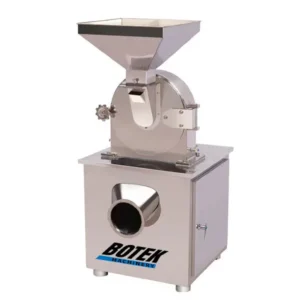
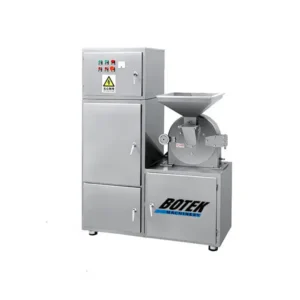
How a Universal Mill Works
A Universal Mill reduces material size through high-speed mechanical impact. Here’s the simple three-step process:
Feed & Accelerate
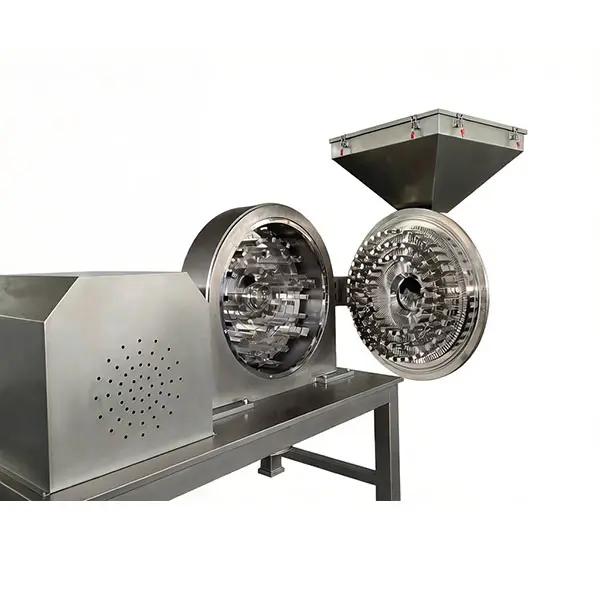
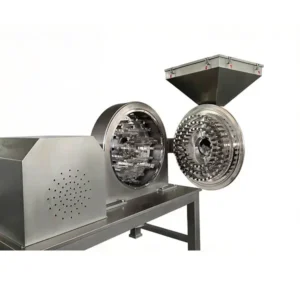
Material enters the grinding chamber and is struck by a high-speed rotor (with hammers, blades, or pegs), throwing particles outward.
Impact & Break
Particles collide with each other and against a stationary serrated liner, breaking down through repeated impact and shear.
Screen & Discharge
Ground material is carried by airflow to a surrounding perforated screen.
✔ Fine particles pass through the screen and exit.
✘ Oversized particles are recycled back for further grinding.
Vantaggi
- Adaptable Rotor Options: Choose from blade, hammer, or peg-and-disc rotors to match your material’s characteristics (brittle, fibrous, tough).
- Patented Screen Cartridge System: Change screens in minutes without tools, drastically reducing downtime between batches.
- Intelligent Airflow Design: Optional suction or pressure air assistance prevents heat buildup and improves throughput for light or fluffy materials.
- Safety First: All models feature interlocked safety switches and robust construction for secure, worry-free operation.
Applications & Materials
Your Go-To Solution for Diverse Grinding Tasks
- From food processing to chemical manufacturing and recycling, our Universal Mill is engineered to perform.
- Food & Feed: Cracking grains, grinding spices, zucchero, dried vegetables, producing breadcrumbs, and processing animal feed.
- Chemicals & Plastics: Size reduction of salts, crystals, synthetic resins, and plastic pellets for recycling.
- Pharmaceuticals: Granule conditioning, coarse grinding of herbal materials and excipients (GMP models available).
- Specialty Industries: Processing wood chips, leather scraps, non-woven fabrics, e altro ancora.
Scheda dati
| Modello | BUM-200 | BUM-300 | BUM-400 | BUM-500 | BUM-600 | BUM-800 |
| Capacity(kg/h) | 10-100 | 30-300 | 50-400 | 80-500 | 100-600 | 300-800 |
| Rotate speed(giri/min) | 4500 | 3800 | 3400 | 2900 | 2000 | 2000 |
| Feed particle size(mm) | 6 | 10 | 10 | 10 | 10 | 12 |
| Discharge particle size(mesh ) | 20-120 | 20-120 | 20-120 | 20-120 | 20-100 | 20-100 |
| Energia(chilowatt) | 4 | 7.5 | 11 | 15 | 22 | 37 |
Configurazione and application of the Universal Mill
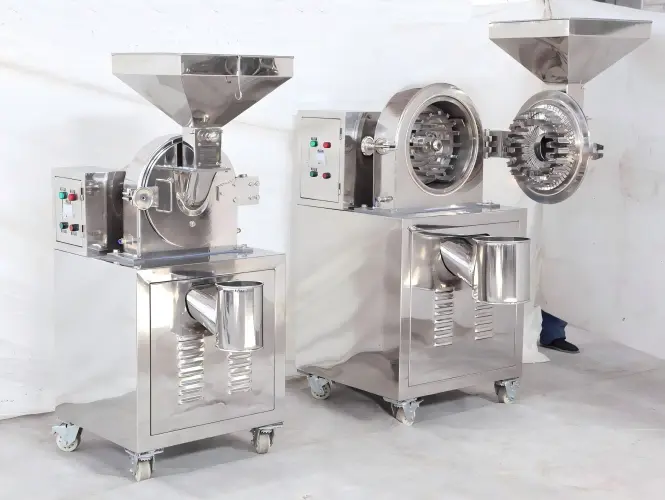
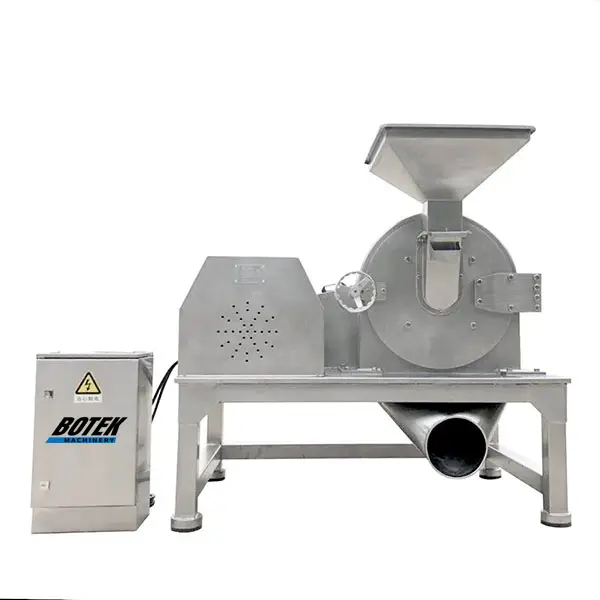
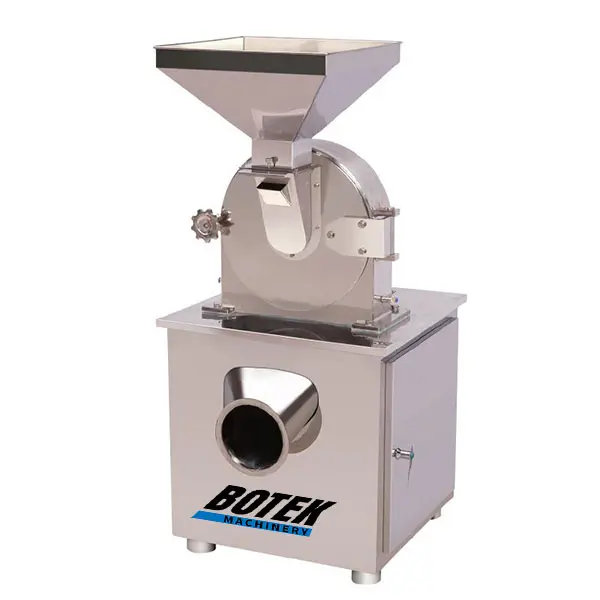
Food Grade Universal Mill with 316L stainless steel
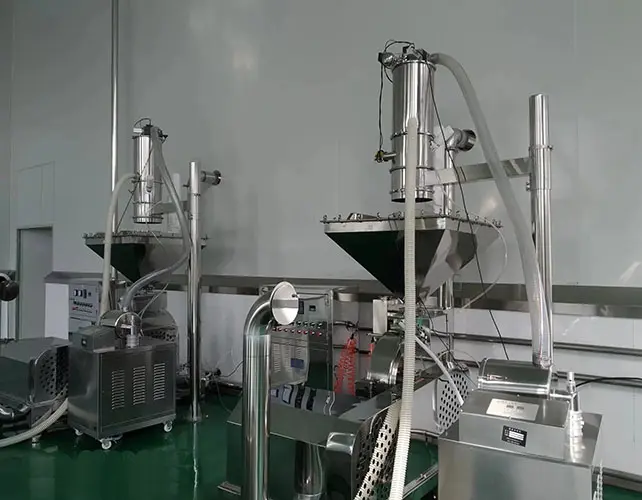
Universal Mill with Vacuum Conveyor
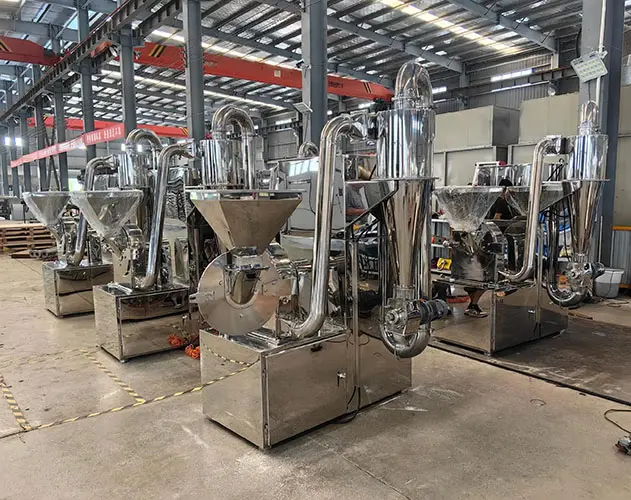
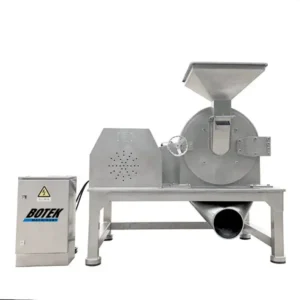
Compact Universal Crusher with Pin Disc
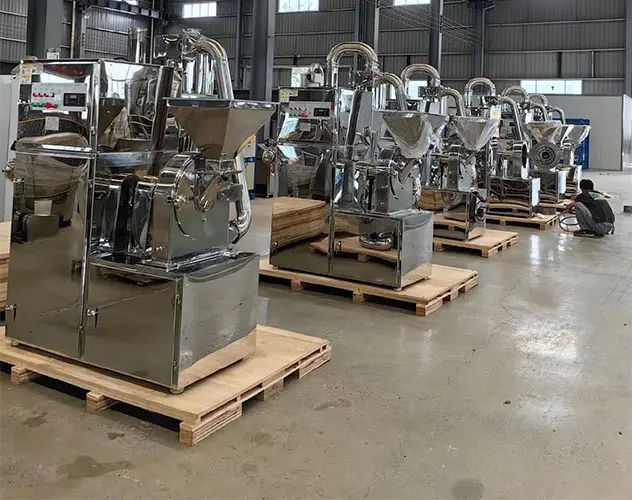
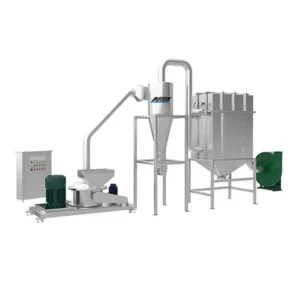
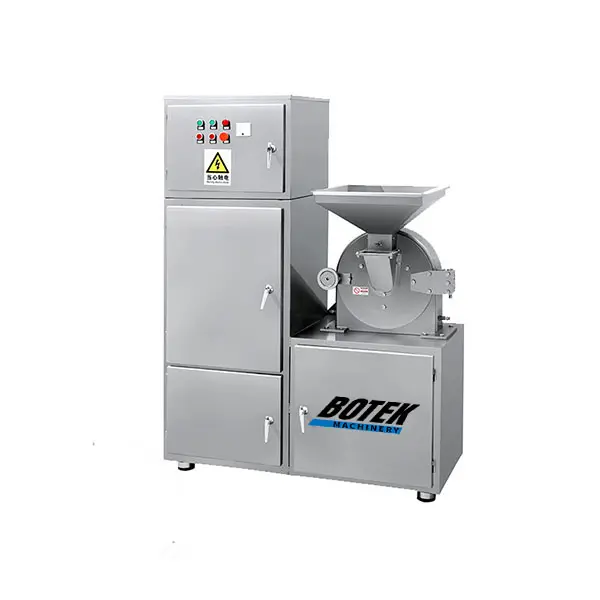
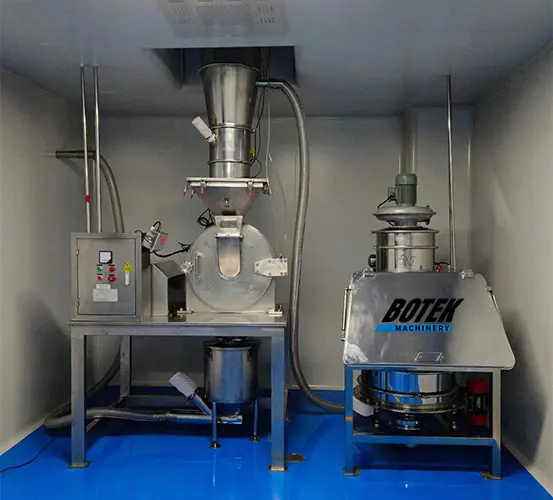
Universal Crusher With Dust Removal System
Beyond the Universal Mill, hai bisogno di altre attrezzature??
Universal Mill FAQS
Universal Mills are highly versatile and suitable for many industries. Common materials include:
Food & Feed: Cereali, spices, zucchero, dried vegetables, breadcrumbs, alimentazione degli animali.
Chemicals & Plastics: Salts, crystalline chemicals, synthetic resins, and plastic pellets (for recycling).
Pharmaceuticals: Herbal materials, excipients (with GMP-compliant designs).
Materiali speciali: Wood chips, leather scraps, and other recyclables.
For heat-sensitive or very hard materials (Mohs >4), we recommend consulting our engineers for a specific solution.
The final particle size is primarily controlled by the interchangeable screen. Our mills can typically produce output ranging from coarse granules (1-6 mm) to medium-fine powders (0.1-1 mm). For consistent results, we provide screens with various aperture sizes (per esempio., 0.5mm, 1mm, 3mm, 6mm). Achieving a uniform particle size distribution relies on selecting the correct screen and maintaining a steady feed rate.
Assolutamente. Siamo più di un semplice produttore di ACM; siamo un fornitore di soluzioni per sistemi completi di lavorazione delle polveri. Progettiamo, produzione, e integrare tutte le principali apparecchiature ausiliarie per creare un'unità senza soluzione di continuità, linea di produzione ad alta efficienza per te.
Le nostre capacità interne includono:
1.Sistemi di alimentazione: Dosatori volumetrici o a perdita di peso per un input costante di materiale.
2.Predimensionamento & Screening:Vagli vibranti e frantoi per garantire dimensioni di alimentazione ottimali per l'ACM.
3.Post-elaborazione & Classificazione:Separatori a ciclone, depolveratori con filtro a maniche ad alta efficienza, e macchine di vagliatura di precisione per garantire la purezza del prodotto finale.
4.Trasporto del prodotto & Gestione: Trasportatori a coclea, sistemi di trasporto pneumatico, e silos di stoccaggio.
5.Imballaggio automatizzato: Confezionatrici per sacchi a valvola, riempitrici di big bag, e sistemi di tenuta.
Offrendo soluzioni integrate chiavi in mano, garantiamo la perfetta compatibilità tra tutti i componenti, fornire un unico punto di contatto per il supporto, e fornire una linea di produzione ottimizzata per il vostro materiale specifico, capacità, e i requisiti del prodotto finale. Questo ti fa risparmiare tempo, riduce i rischi di interfaccia, e garantisce le prestazioni complessive del sistema.
The main factors are:
Proprietà dei materiali: Density, hardness, initial size, and moisture content.
Desired Final Particle Size: Finer grinding requires more energy and may reduce throughput.
Screen Size & Rotor Configuration.
Offriamo modelli con potenza motore da 7.5 kW a 90+ kW and capacities from 200 kg/h to over 10,000 kg/h. For an accurate recommendation, please provide your material details for a free grinding test.
vs. Hammer Mill: A Universal Mill is often more robust and offers greater versatility through easily interchangeable rotors (not just hammers) and screens. It’s generally designed for higher precision in particle size control across a broader range of materials.
vs. Mulino per la classificazione dell'aria (ACM): An ACM uses an air classifier for ultra-fine grinding (down to 5-10 micron) and is ideal for heat-sensitive materials. A Universal Mill uses mechanical screens for coarser grinding (100+ micron), excels at high-throughput bulk processing, and is simpler and more cost-effective for applications not requiring ultra-fine powder.
Our Universal Mills are designed for easy cleaning and quick changeover. Le caratteristiche principali includono:
Quick-Access Doors: Allow full entry to the grinding chamber.
Tool-Free Screen & Rotor Changes: Patented clamping systems enable component swaps in under 30 minutes.
Liscio, Polished Surfaces: Minimize material adherence and simplify cleaning, essential for food and pharmaceutical GMP standards.
Routine maintenance primarily involves inspecting and replacing wear parts like screens and hammers.
Assolutamente. We provide extensive customization options:
Materiali da costruzione: Carbon steel, food-grade stainless steel (304/316l).
Special Features: A prova di esplosione (ATEX) motors, dust-proof housings, nitrogen inerting systems, water-cooled bearings.
Integration: Custom feed hoppers, screw feeders, and connections to pneumatic conveying or sieving systems.