
Nel mondo delle lavorazioni industriali, raggiungimento di un risultato coerente, homogeneous blend of dry powders and solids is a critical challenge. Among the various types of industrial mixers, the ribbon mixer stands out for its efficiency, reliability, and simple yet effective design. But what is the fundamental ribbon mixer working principle that makes it so effective?
Botek machinery will provides a comprehensive guide to the ribbon blender working principle, its key components, and the advantages it offers for powder blending and solid mixing operations.
What is a Ribbon Mixer?
A ribbon mixer, also known as a ribbon blender, is a type of industrial mixer specifically designed for blending dry powders, granuli, and other free-flowing solid materials. It consists of a U-shaped or cylindrical trough and a central shaft equipped with a unique spiral ribbon agitator. This design is engineered for high-performance powder mixing across industries like food and beverage, prodotti farmaceutici, prodotti chimici, and plastics.
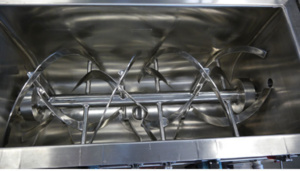
Core Components of a Ribbon Blender
Before diving into the ribbon mixer working principle, it’s essential to understand its key parts:
Trough: The stationary container, typically U-shaped, that holds the materials to be mixed.
Agitator Shaft: The central shaft that runs the length of the trough.
Spiral Ribbon Agitator: The defining component. It consists of an inner and outer helical ribbon (or screw) welded to the shaft. The ribbons are pitched to push material in opposite directions.
Drive System: A motor and gearbox that provide the power to rotate the agitator shaft.
Discharge Valve: An outlet, often at the bottom of the trough, for emptying the blended product efficiently.
The Ribbon Mixer Working Principle Explained
The operating principle of a ribbon blender is elegantly simple, relying on a combination of convective and shear mixing actions. Here’s a step-by-step breakdown of the ribbon blender working principle:
Caricamento: The dry ingredients are loaded into the trough, typically filling between 40% A 70% of its total capacity. This “headspace” is crucial for allowing the materials to move freely.
Agitation and Material Movement: Once the motor is started, the central shaft rotates, turning the spiral ribbon agitator. This is where the core mixing action happens:
The outer ribbon is pitched to push the bulk of the material in one direction (typically towards the ends of the trough).
The inner ribbon is pitched in the opposite direction, pushing material towards the center of the trough.
Dual-Flow Mixing Action: This counter-current movement is the heart of the ribbon mixer working principle. The opposing forces created by the two ribbons cause the powder particles to move in two streams—radially (around the shaft) and axially (along the length of the trough). This creates a rapid and intense cross-flow of materials.
Achieving Homogeneity: As the materials are constantly split and folded into each other by the ribbons, they are thoroughly blended. The shearing action between the moving particles and the ribbons themselves helps to break down lumps, ensuring a uniform, homogeneous mixture in a relatively short time.
Scarico: After the mixing cycle is complete, the discharge valve is opened. The continued rotation of the ribbons acts as an Archimedes screw, efficiently conveying the finished blend out of the trough. The ribbon blender discharge is often rapid and complete, leaving minimal residue.
Advantages of the Ribbon Blender Design
The effectiveness of the ribbon mixer working principle translates into several key benefits:
Fast, Efficient Mixing: The convective mixing action achieves homogeneity quickly.
Thorough Blending: Excellent for blending powders with minor differences in density or particle size.
Gentle Handling: The low-shear action is ideal for fragile materials that must not be broken down.
Easy to Clean and Maintain: Many models are designed with sanitary standards in mind, supporting easy cleaning-in-place (CIP) systems.
Applications of Ribbon Mixers
Thanks to its versatile working principle, the ribbon mixer is used for:
Blending dry food powders (flour, spices, seasonings).
Mixing pharmaceutical formulations.
Combining chemical compounds and plastics.
Incorporating minor ingredients like liquids or fats into a dry base (per esempio., for powder mixing in animal feed).
Conclusion
The ribbon mixer working principle is a masterpiece of mechanical efficiency. By utilizing a dual-action spiral ribbon agitator to create a controlled, counter-current flow of materials, it delivers fast, uniform, and reliable blending for a wide range of dry solids. Whether you are in food production, prodotti farmaceutici, or chemical manufacturing, understanding this principle is key to selecting the right industrial powder mixer for your needs, ensuring product quality and operational efficiency.