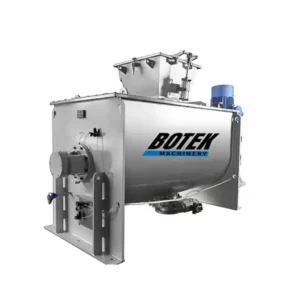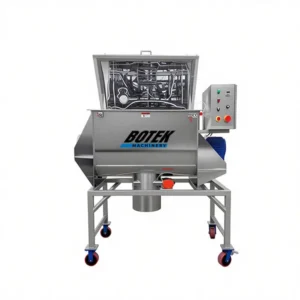
Twin-Shaft Paddle Mixer: Your Machine for Fast, Perfect Mixi ng.Looking for a powerful, reliable, and efficient industrial mixer? Our high-performance Twin-Shaft Paddle Mixer is designed to deliver perfectly uniform blends for powders, granules, and other dry materials. It solves common mixing problems like uneven results, long cycle times, and difficult cleaning.
What is a Twin-Shaft Paddle Paddle Mixer?
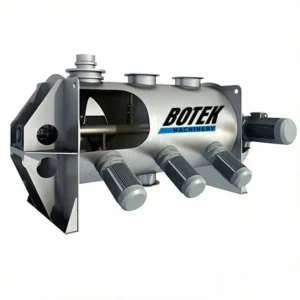
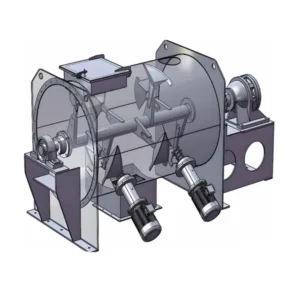
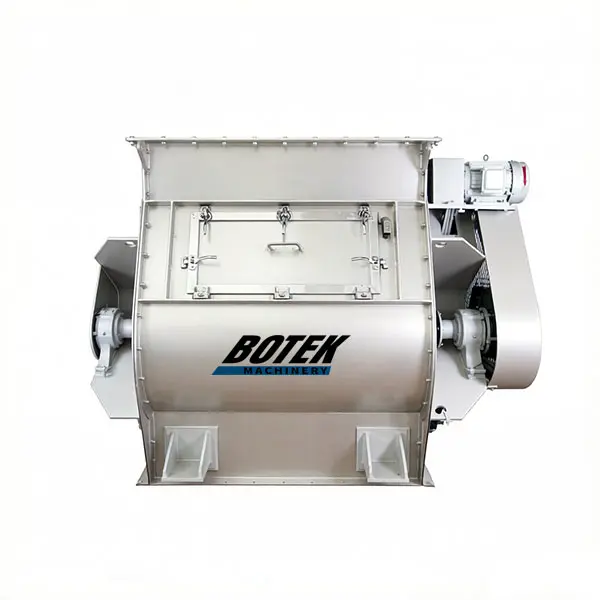
Our twin-shaft paddle mixer, also known as a non-gravity or intensive mixer, uses two horizontal shafts with specially angled paddles. These paddles rotate in opposite directions, creating a unique “figure-eight” mixing action. This ensures every single particle is moved, cut, and blended with incredible speed and consistency. Unlike simple tumble mixers, this machine guarantees a 100% homogeneous mix batch after batch.
Why Choose Us
- Fast & Consistent Mixing: Achieve a perfectly uniform blend in just 1-5 minutes, dramatically increasing your production output.
- Handle Many Materials: Ideal for mixing dry powders, fine chemicals, food ingredients, spices, fertilizers, plastics, and minerals.
- Easy to Clean & Maintain: The smooth interior and accessible design allow for quick product changeover. Minimal dead zones mean less waste and easier cleaning.
- Gentle Yet Thorough: The paddle design ensures a complete mix without damaging fragile particle structures, protecting your product quality.
- Built to Last: Made from high-quality food-grade 304 or 316 stainless steel, and carbon steel. Robust construction ensures reliable performance for years with low maintenance.
Key Features & Technical Advantages
- High Mixing Efficiency: Unique overlapping paddle design for 100% mixing homogeneity.
- Short Mixing Time: Significantly faster than ribbon or tumble mixers, saving you time and energy.
- Multiple Discharge Options: Manual slide gate, pneumatic valve, or even screw conveyor for smooth, dust-free unloading.
- Customizable Options: Available in sizes from 50L to 5000L. We can customize the finish, jacket for heating/cooling, spray nozzles for liquid addition, and PLC control systems.
Data Sheet
| Model | Volume(M³) | Filling Ratio | Power(KW) | Machine Weight(kg) |
| BTS-0.2 | 0.2 | 0.4-0.6 | 4 | 280 |
| BTS-0.5 | 0.5 | 0.4-0.6 | 7.5 | 850 |
| BTS-1 | 1 | 0.4-0.6 | 11 | 1200 |
| BTS-1.5 | 1.5 | 0.4-0.6 | 15 | 1600 |
| BTS-2 | 2 | 0.4-0.6 | 18.5 | 2800 |
| BTS-2.5 | 2.5 | 0.4-0.6 | 22 | 4200 |
| BTS-4 | 4 | 0.4-0.6 | 22 | 4500 |
| BTS-5 | 5 | 0.4-0.6 | 37 | 6000 |
| BTS-6 | 6 | 0.4-0.6 | 45 | 7000 |
| BTS-10 | 10 | 0.4-0.6 | 55 | 8000 |
| BTS-12 | 12 | 0.4-0.6 | 55 | 10500 |
| BTS-15 | 15 | 0.4-0.6 | 55 | 10000 |
Note: Show Only Some Models
Twin-Shaft Paddle Mixer | Customer Projects & Real Applications
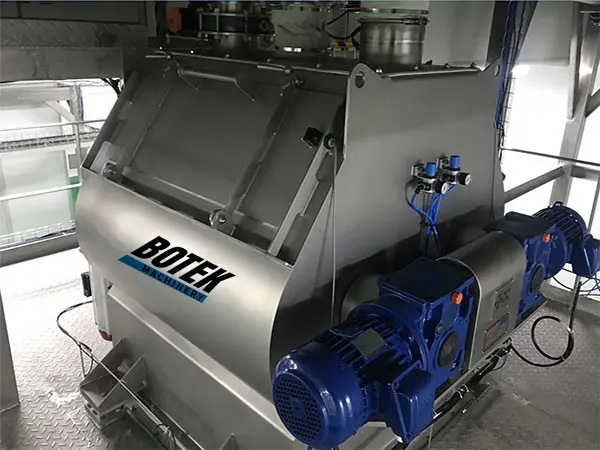
An ATEX-certified Twin-Shaft Non-Gravity Mixer installed at a chemical plant in Spain for secure powder blending
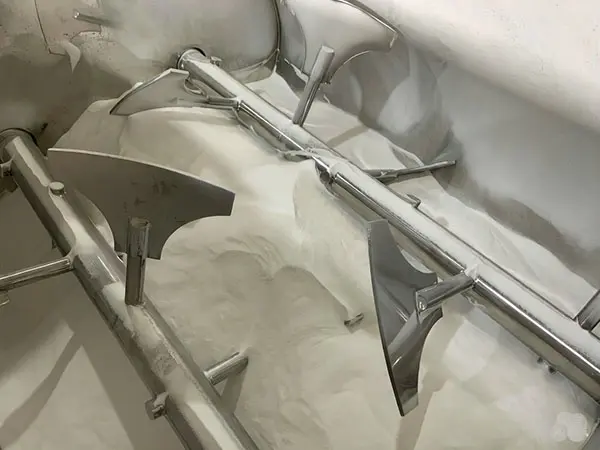
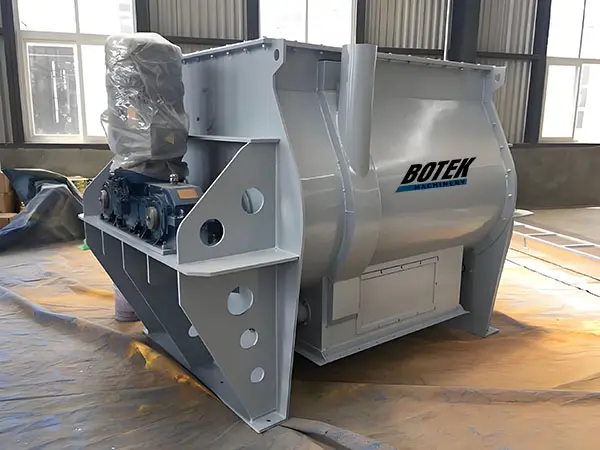
A heavy-duty carbon steel twin-shaft paddle mixer for blending dry mortar materials at a construction materials plant in the Middle East
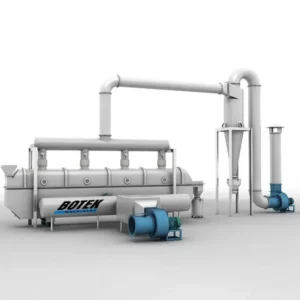
Need More Than Just a Blender? We Build Complete Production Lines
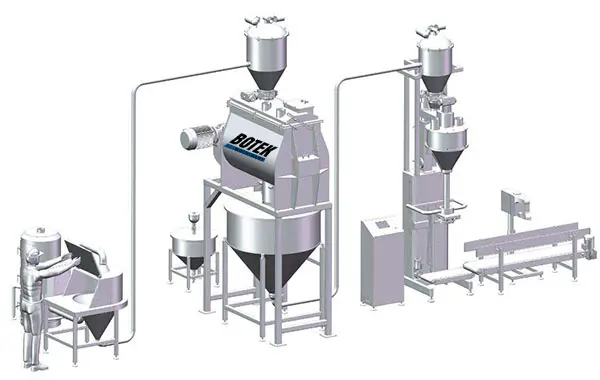
twin-shaft paddle mixer FAQS
The key advantages are superior mixing uniformity, shorter mixing time, and easier cleaning. Unlike ribbon mixers which primarily create a shear action, the twin-shaft design provides a more intensive three-dimensional movement, virtually eliminating dead zones. This results in a mixing coefficient of variation (CV) of ≤5%, compared to 8-15% in many ribbon mixers. Furthermore, the smooth paddles and full-open discharge valve allow for complete, rapid discharge and significantly reduce residue and cleaning time.
This mixer is highly versatile and ideal for a wide range of dry to semi-dry materials, including:
Powders: Flour, spices, protein powders, cement, pigments.
Granules: Plastic pellets, fertilizers, grains, detergents.
Fibrous Materials: Tobacco, cellulose, shredded paper.
Others: Products with slight additives or coatings. It is particularly effective for materials with significant differences in particle size, density, or flow characteristics.
Absolutely. Customization is our strength. We do not just sell standard machines. We engineer solutions based on your:
Batch Capacity: From lab-scale 50L to industrial 20,000L.
Material Characteristics: Bulk density, abrasiveness, moisture.
Process Requirements: Heating/cooling jackets, liquid addition spray systems, vacuum drying capability, specific material of contact (304/316L stainless steel, carbon steel,special coatings).
Certification Needs: CE, ATEX for explosive atmospheres, USDA, FDA-compliant finishes,UL, CSA.
Selecting the correct capacity is critical. It is determined by your working volume, not total volume. We recommend a working volume of 30%-70% of the total mixer volume for optimal efficiency. Follow this 3-step guide:
Determine Batch Size: Calculate the weight (kg) of one complete batch of your material.
Calculate Bulk Volume: Divide the batch weight by your material’s bulk density (kg/m³). This gives you the required working volume in cubic meters (m³).
Select Mixer Size: Choose a mixer whose working volume range encompasses your calculated figure. Example: For a 2,000kg batch of powder with a bulk density of 500 kg/m³, you need 4 m³ of working volume. A 6 m³ total volume mixer (with a 3-4.2 m³ working range) would be ideal.
Pro Tip: Always consult with our engineers. We provide free capacity calculation services based on your sample to prevent under or over-sizing.
For standard models, the lead time is 3-5 weeks. For fully customized lines, it depends on the scope of engineering, typically 4-6 weeks. We provide comprehensive support, including:
Detailed foundation drawings and utility requirements.
Supervision of installation and commissioning by our experienced engineers.
On-site operational and safety training for your team.
A comprehensive spare parts list and global after-sales support.
Yes, with the correct configuration. For homogeneous liquid-solid blending, we equip the mixer with a high-pressure spray system and optionally, high-speed chopper blades. The liquid is atomized and sprayed onto the turbulent bed of dry materials, while the choppers (if equipped) break up any forming lumps. This ensures even coating without balling, essential for flavors, oils, or binders in food and feed production.