
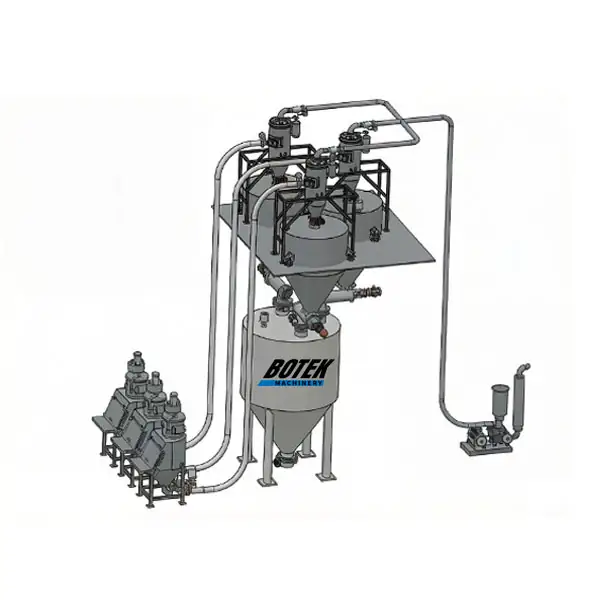
What is a Weighing & Batching System?
A weighing and batching system is a fully integrated industrial solution designed to accurately measure, mix, and dispense bulk powder or granular materials according to predefined recipes. Unlike manual weighing, our automated system ensures consistent batch-to-batch uniformity, reduces human error, and maximizes production throughput. Ideal for industries such as chemicals, plastics, food processing, pharmaceuticals, and construction materials.
How Our Weighing & Batching System Works
1. Material Loading: Bulk powder is fed into storage tanks via manual loading or automated unloading systems.
2. Inventory Monitoring: BinTrac-style level sensors provide real-time stock visibility.
3. Recipe Selection: Operator selects a batch recipe via HMI – system automatically calculates required weights.
4. Precise Dosing: System opens feeders sequentially, measuring each ingredient by weight until target is reached.
5. Mixing & Discharge: Batched materials are discharged into mixer or next station for processing.
6. Data Logging & Reporting: System logs batch data, weights, timestamps, and operator IDs for quality control.
Key Components of Our Weighing & Batching System
Our system is built for reliability and performance. Here’s what you get:
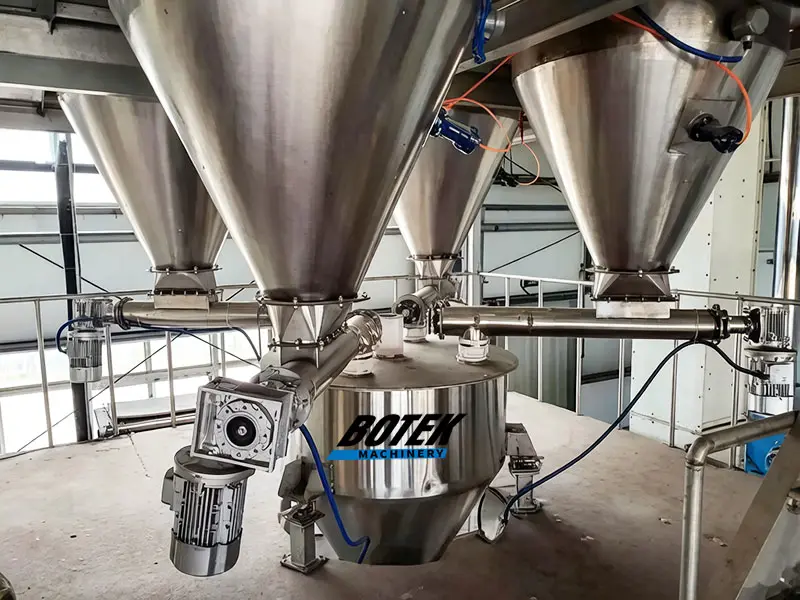
1. Material Storage Tanks / Silos
Stainless steel or carbon steel options
Equipped with level sensors and access hatches
Designed for dust-free storage and easy maintenance
2. Precision Weighing Hoppers / Bins
Load cells integrated for real-time weight measurement
Anti-vibration and thermal compensation for stable readings
3.Powder Feeding & Conveying System
Screw feeders, rotary valves, or pneumatic conveyors
Controlled feed rate for accurate dosing
4. Automatic Weighing & Batching Controller (PLC + HMI)
Programmable logic controller with intuitive touchscreen interface
Recipe management with multiple formulas
Real-time data logging for compliance and traceability
5. Discharge & Collection System
Integrated with mixers, packaging lines, or downstream processing equipment
Dust-tight connections to maintain cleanliness
6. Safety & Monitoring Features
Emergency stop buttons, overload protection, and alarm systems
Visual and audible alerts for operator safety
Gain-in-Weight vs. Loss-in-Weight Batching
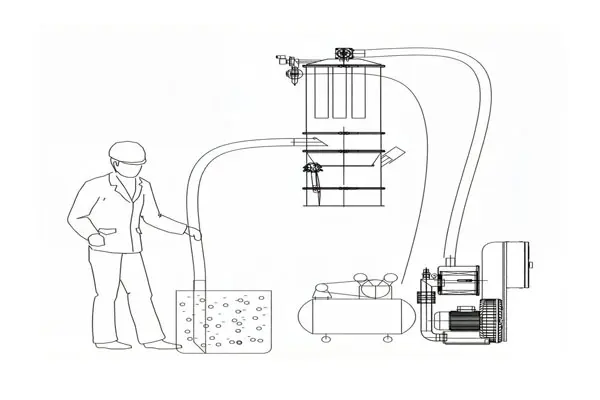
Choosing the right batching methodology is critical for operational efficiency. Our weighing and batching system offers both Gain-in-Weight (GWI) and Loss-in-Weight (LIW) configurations, each engineered to deliver unmatched precision in different production scenarios. Let our experts help you select the optimal method for your application.
What is Gain-in-Weight (GWI) Batching?
(Also known as In-Motion or Sequential Batching)
In a Gain-in-Weight system, a central weighing hopper is suspended on high-accuracy load cells. Ingredients are fed into this single hopper sequentially. The controller measures the accumulated weight gainof each ingredient as it is added, stopping the feeder once the target weight for that component is reached.
How it works:
The system starts with an empty weigh hopper (tare weight).
Feeder 1 opens, adding Ingredient A. The controller monitors the weight increase until the recipe target is met, then stops Feeder 1.
Feeder 2 opens, adding Ingredient B to the same hoppercontaining Ingredient A. The controller now monitors the totalweight to add the precise amount of B.
This process repeats for all ingredients in the recipe.
Finally, the complete batch is discharged from the hopper for mixing or further processing.
Key Advantages:
Cost-Effective: Only one set of high-precision load cells and one weigh hopper are required, regardless of the number of ingredients.
High Accuracy for Large Batches: Excellent for batching large quantities where slight cross-contamination is acceptable.
Simplicity: Easier to clean and maintain due to fewer weighing points.
Ideal Applications:
✔ Construction Materials (dry mortar, concrete)
✔ Animal Feed & Fertilizers
✔ Large-volume chemical batching where recipe changes are infrequent.
What is Loss-in-Weight (LIW) Batching?
(Also known as Continuous or Independent Batching)
A Loss-in-Weight system takes the opposite approach. Each ingredient has its own dedicated feeder and weigh hopper (or supply vessel mounted on load cells). Instead of measuring what goes intoa central hopper, the system precisely measures the weight lostfrom each ingredient’s supply as it is discharged.
How it works:
Each ingredient hopper is filled and weighed initially.
During batching, all feeders discharge their ingredients simultaneously into a common mixer or collection point downstream.
The controller on each line monitors the weight lossof its hopper in real-time.
By controlling the feeder speed based on the real-time weight loss rate, the system delivers a precise, continuous, and gravimetricfeed of each component.
Batching is complete when each hopper has lost the exact weight specified in the recipe.
Key Advantages:
Superior Accuracy & Consistency: Continuous gravimetric control compensates for material density changes, ensuring ±0.1% to ±0.25% accuracy.
Simultaneous Dosing: All ingredients are fed at the same time, drastically reducing total batch cycle time.
No Cross-Contamination: Ingredients are kept completely separate until the mixing point.
Ideal for Continuous Processes: Can be seamlessly integrated into continuous mixing or extrusion lines.
Ideal Applications:
✔ Food & Beverage (spice blends, baking mixes)
✔ Pharmaceuticals (API & excipient blending)
✔ Plastics Compounding & Masterbatch
✔ High-value chemicals requiring stringent formula integrity.
Configuration and application of the Open-Mouth Bagging Machine
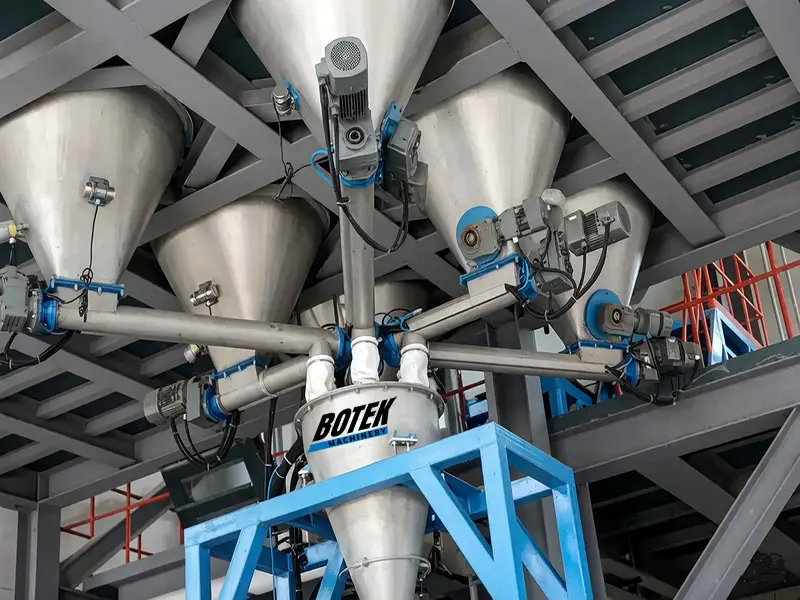
A title
Image Box text
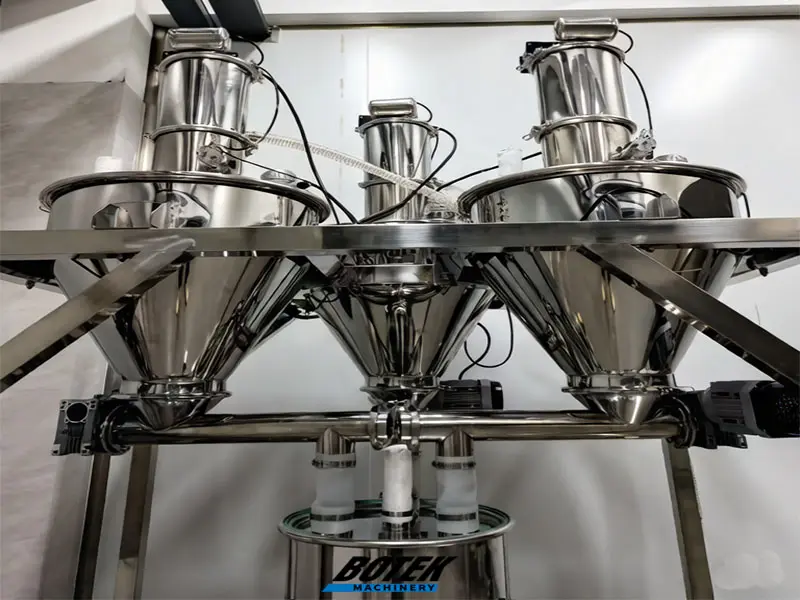
A title
Image Box text
A title
Image Box text
Beyond the Open-mouth packing machine, do you need other equipment?
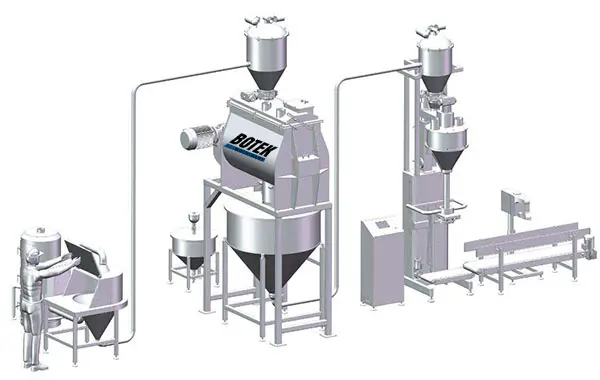
Beyond the Open-mouth packing machine, do you need other equipment?
This is a fundamental choice. Gain-in-Weight sequentially adds ingredients to a single weigh hopper. It’s cost-effective and ideal for larger batches where slight cross-contamination is acceptable (e.g., animal feed, dry mortar). Loss-in-Weight uses individual hoppers for each ingredient, discharging simultaneously by measuring weight loss. It offers superior accuracy (±0.1%), prevents cross-contamination, and is faster, making it perfect for high-value or sensitive materials (e.g., pharmaceuticals, masterbatch). Our engineers will analyze your material value, recipe complexity, and required throughput to recommend the optimal method.
Our standard systems achieve accuracies between ±0.1% to ±0.5% of target weight, depending on the configuration (LIW typically being more precise). Accuracy can be influenced by:
Material Characteristics: Extremely fine powders (<10 microns), sticky, or floodable materials require specialized feeder design.
Environmental Factors: Strong vibrations, air currents, or large temperature swings. Our systems feature anti-vibration mounts and thermal compensation.
Mechanical Setup: Proper installation and regular calibration are crucial. We provide detailed commissioning protocols.
Our PLC-based controller with a user-friendly HMI (Touchscreen) can store hundreds of recipes. Changing a batch is as simple as:
Operator selects the desired recipe from the password-protected menu.
The system automatically pulls the correct ingredient weights and sequencing.
The batch runs automatically. This minimizes changeover time and prevents operator error.
Yes, our system is designed for full traceability. For each batch, it logs:
Recipe name/ID, batch number
Target vs. actual weight for each ingredient
Timestamps for start, end, and any alarms
Operator login ID
This data is stored securely and can be exported as reports (PDF, CSV) or integrated via OPC/Modbus into your MES/ERP. We offer optional features like electronic signatures and audit trails for full FDA/GMP compliance.
Seamlessly. Our systems are built with open architecture.
Physical Integration: Discharge chutes, valves, and interfaces are custom-designed to fit your existing mixer inlet, reactor, or conveyor.
Software Integration: Our PLC supports industry-standard communication protocols: Modbus TCP/IP, Ethernet/IP, Profinet, and OPC UA. We can provide APIs for direct integration with your SAP, Oracle, or custom MES for real-time production data exchange.
Control is via an intuitive, icon-based touchscreen HMI (Human-Machine Interface). The interface is typically available in multiple languages. Key features include:
Visual process flow diagram showing real-time status.
One-touch start/stop for recipes.
Clear alarm messages with troubleshooting guidance.
Most operators become proficient after 1-2 days of on-site training provided by our engineers.
Lead time depends on complexity. A standard modular system can be ready in 6-8 weeks. A fully custom, large-scale solution may take 10-15 weeks. We provide a detailed project timeline after the initial technical review.