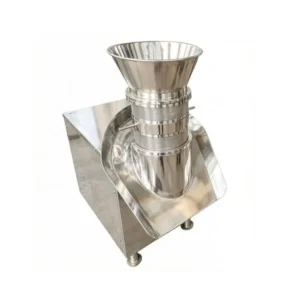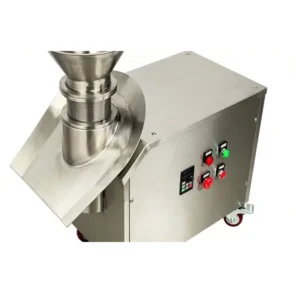
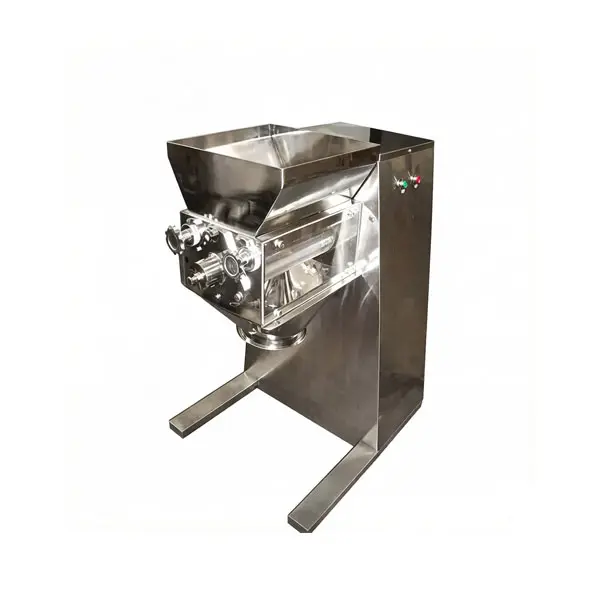
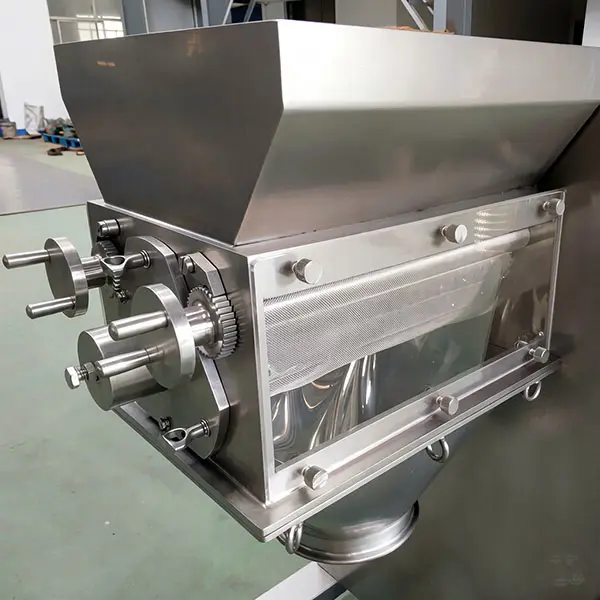
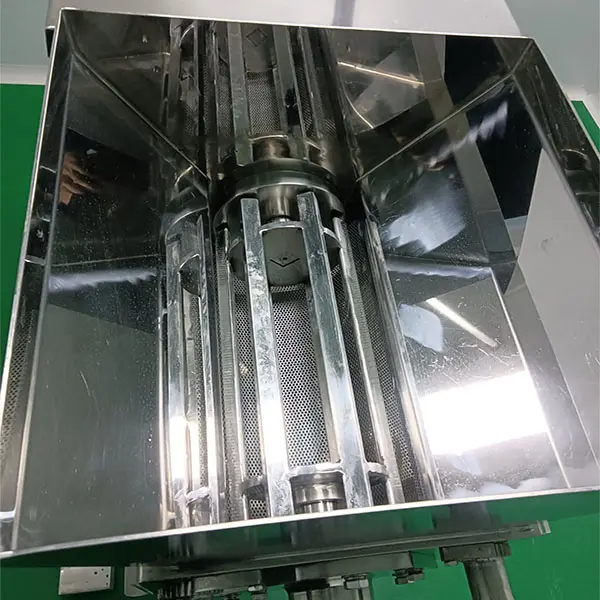
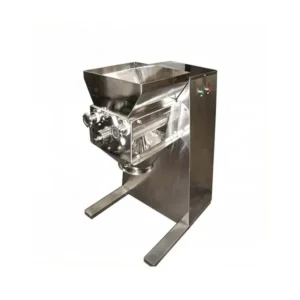
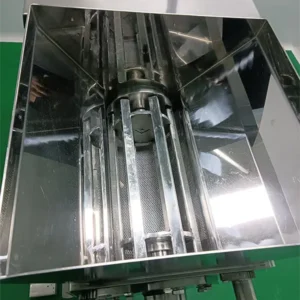
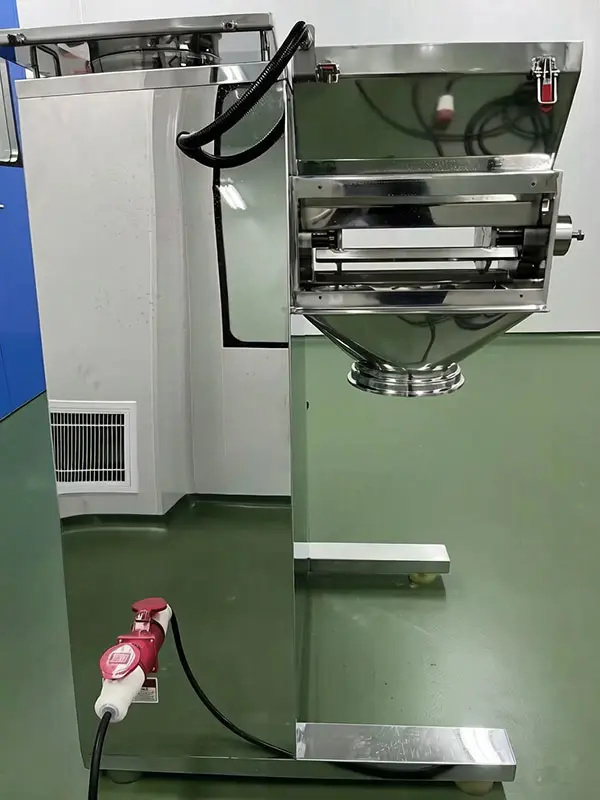
The Oscillating Granulator is a precision mechanical granulator engineered for transforming agglomerated powders into uniform, free-flowing granules. Its oscillating rotor mechanism provides controlled mechanical action to process material through a cylindrical screen, delivering consistent particle sizing and shape.
Process Application & Material Suitability
This machine excels in two primary roles within granulation workflows:
- In dry granulation processes, it serves as an efficient granulator/sizer for milled compacted ribbons or flakes.
- In wet granulation lines, it acts as a wet mass granulator, processing conditioned powder blends into well-defined wet granules prior to drying.
Ideal Material Characteristics: The Oscillating Granulator achieves optimal performance with materials exhibiting good friability and low to moderate moisture content—typically dry compacts or semi-dry, crumbly wet masses. Its design ensures reliable operation with these material types while maintaining excellent granule uniformity and throughput.
Key Technical Advantages
- Dual-Process Compatibility: One machine, two applications. Suitable for sizing dry granules in dry granulation and forming wet granules in wet granulation.
- Superior Granule Quality: Produces uniform particle size, high density, excellent flowability, and minimal dust. Ideal for subsequent tableting, packaging, or mixing.
- Gentle & Reliable Operation: The mechanical oscillating principle applies mild force, generates low heat, and preserves material properties—ideal for heat-sensitive ingredients.
- GMP-Compliant Design: All product contact parts are made of 304 or 316L stainless steel. High surface finish, no dead zones, fully disassemblable for thorough cleaning and sterilization.
- Easy Operation & Maintenance: Modular design. Screens and scraper blades can be changed quickly without tools, minimizing downtime for product changeover.
- Customization Flexibility: Available with various screen sizes (typically 0.5-6mm), materials (stainless steel, special alloys), and capacity models (50-800 kg/h). Can be integrated with automated feeding and discharge systems.
Typical Applications
- Pharmaceutical: Sizing dry compacted ribbons from roller compactors (Dry Granulation). Sizing wet mass before drying (Wet Granulation) for tablets, capsules, and granules.
- Food & Nutraceuticals: Granulating dry powder mixes, especiarias, instant drink powders, protein blends, and vitamin premixes.
- Chemical Industry: Processing detergent powders, fertilizer granules, and pigment agglomerates.
Data Sheet
| Model | Capacity(kg/h) | Particle diameter(mm) | Rolling speed(rpm) | Roller Diameter(mm) | Power(kw) | Weight(kg) | Dimensions(mm) |
| BSG-160 | 100-200 | 0.5-3 | 65 | 160 | 3 | 150 | 900X700X1150 |
| BSG-160C | 150-300 | 0.5-3 | 55 | 160 | 4 | 200 | 900X700X1150 |
| BSG-250 | 200-400 | 0.5-3 | 55 | 250 | 5.5 | 300 | 1260X750X1250 |
Configuration and application of the Double Cone vacuum dryer
Um título
Texto da caixa de imagem
Um título
Texto da caixa de imagem
Um título
Texto da caixa de imagem
Beyond the VFB Dryer, do you need other equipment?
Double cone vacuum Dryer FAQS
Granule size is primarily determined by the screen aperture. Simply change the screen to achieve the target particle size. The oscillating speed can also be adjusted for fine-tuning.
Cleaning is simple and fast. The screen cylinder, rotor, and hopper are designed for quick release without tools, enabling full access for cleaning and inspection, meeting strict GMP requirements.
The machine performs optimally with materials that are friable, lightly moistened, or in dry compacted form. Typical examples include:
Dry-milled compacted ribbons from a roller compactor
Conditioned wet masses with low to moderate binder content (just beyond the “snowball” stage, but not tacky)
Delumped dried granules or agglomerated powders
Materials that are highly wet, sticky, gummy, or paste-like are not recommended, as they tend to clog the screen and reduce efficiency. For such materials, an extrusion-type granulator is more appropriate.
Selection depends on:
Material properties: Moisture content, bulk density, flowability, abrasiveness.
Desired capacity: Throughput (kg/h) and batch size.
Target granule size: Screen aperture and L/D (length/diameter) ratio.
Process requirements: CIP/SIP needs, containment level, explosion-proofing.
We recommend providing a sample for a lab test to determine optimal screen type, rotor speed, and throughput.
Consider your batch size, material characteristics (bulk density, moisture content), and required drying time. We can help you test your material in our lab and recommend the optimal size and configuration.