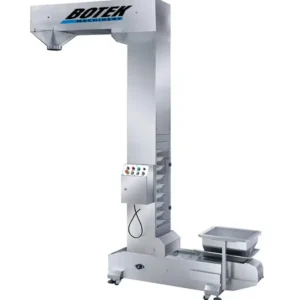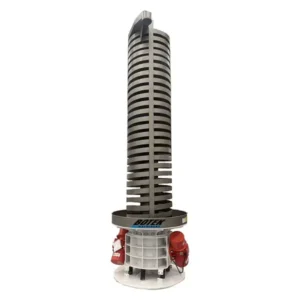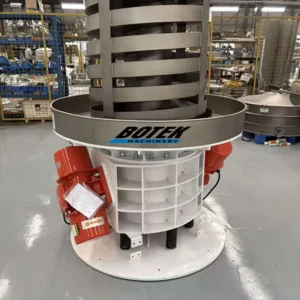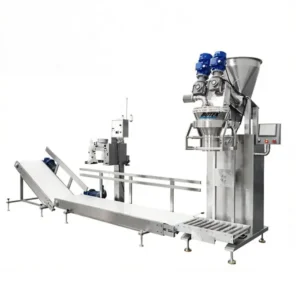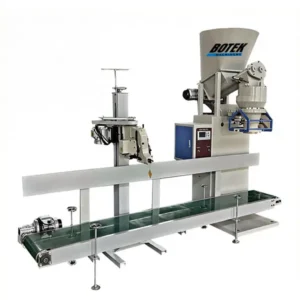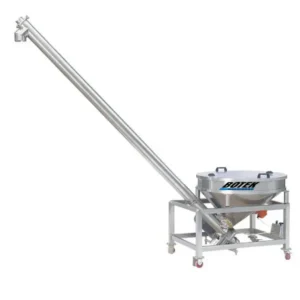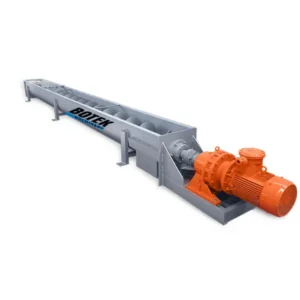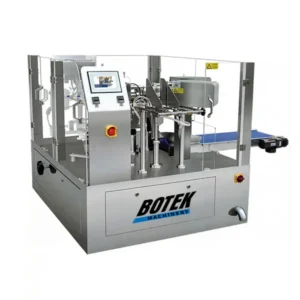
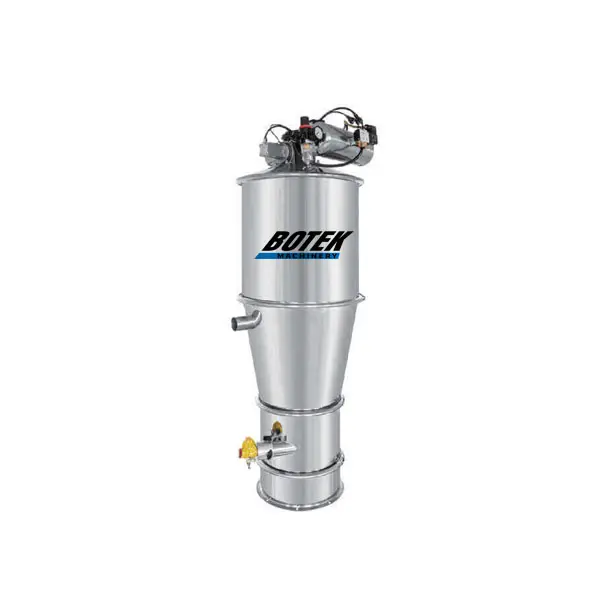
Botek’s industrial Vacuum Conveyors (also called vacuum powder conveyors or pneumatic conveyors) provide a closed, automated solution for moving dry powders, حبيبات, and small pellets. They are the clean, safe, and reliable choice for food, الصيدلانية, chemical, and plastic processing plants.
What is a Vacuum Conveyor?
A vacuum conveyor is a pneumatic system that uses suction (vacuum) to gently move dry materials from one place to another through a sealed hose or pipe. It works like a powerful, industrial vacuum cleaner designed for production environments. It is perfect for loading mixers, grinders, packaging machines, and silos without dust, contamination, or product loss.
How Does a Vacuum Conveyor Work? (Simple 3-Step Process)
The core principle is simple and reliable:
- Suction (Vacuum Creation):
A vacuum pump (electric or pneumatic) generates suction.
This suction pulls material from the source container (drum, big bag, etc.) into the conveying hose. - نقل & Separation:
The material travels through the hose into a receiver vessel on the machine.
Inside the vessel, a filter separates the powder from the air. The clean air passes through the filter and exits, while the material collects at the bottom. - تسريح:
The vacuum stops.
A discharge valve (often a flap or dome valve) at the bottom of the vessel opens.
The material falls by gravity into the target machine (like a mixer or hopper).
The valve closes, and the cycle repeats.
Types of Vacuum Conveyor
1.Pneumatic Vacuum Conveyor
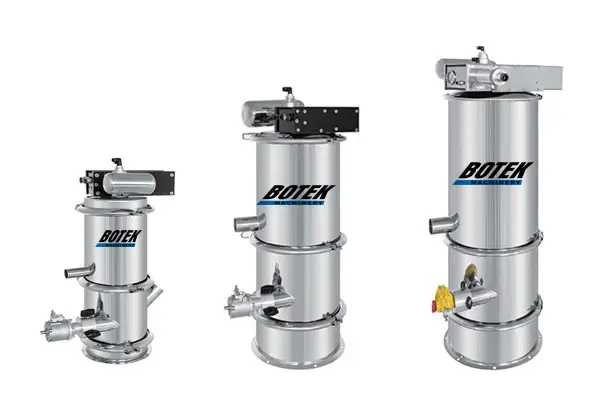
This system uses a vacuum generator (often powered by compressed air) to create suction, gently drawing powders and granules through a sealed hose or pipe. Its simple, non-mechanical operation makes it ideal for short-distance transfers (typically under 10 meters) and low to medium throughput applications.
| Model | BP-1 | BP-2 | BP-3 | BP-4 |
| Capacity(KG) | 50-300 | 100-400 | 200-600 | 600-1200 |
| Air flow (L/min) | 180 | 360 | 720 | 1440 |
| Air supply pressure(Mpa) | 0.4-0.6 | 0.4-0.6 | 0.4-0.6 | 0.4-0.6 |
| Dimensions(mm) | φ140×560 | φ213×720 | φ290×850 | φ420×1150 |
2. Electric Vacuum Conveyor
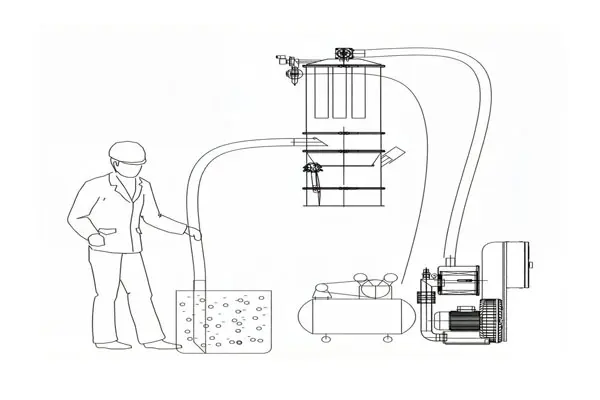
Unlike compressed-air-driven systems, an electric vacuum conveyor utilizes an integrated electric vacuum pump to generate suction. This self-contained design eliminates the need for an external compressed air supply, making it more energy-efficient and suitable for facilities where compressed air is limited or costly.
It is ideal for short to medium-distance transfers and offers consistent, quiet operation with adjustable vacuum power.
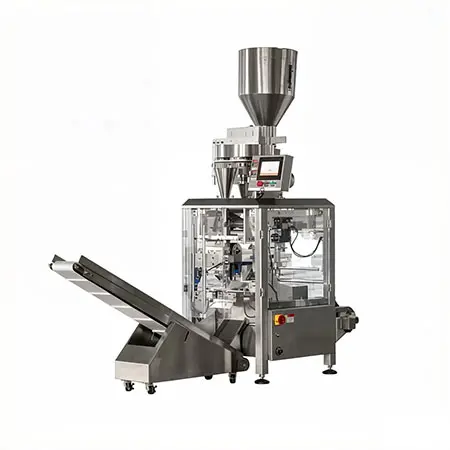
An intermittent vacuum conveyor works in a fill-and-discharge cycle: it creates vacuum to draw material into a receiver vessel, then releases the vacuum to discharge the batch. The process repeats automatically at set intervals.
Features And Best For:
Cyclic operation, suitable for batching or dosing.
Shorter distances and lower throughput.
Precise control over batch size.
Common in small-scale production, batch mixing, or feeding machines that process material in defined quantities.
Both types can be driven by compressed air (vacuum generator) or an electric pump, selected based on plant utilities, material characteristics, and production rhythm.
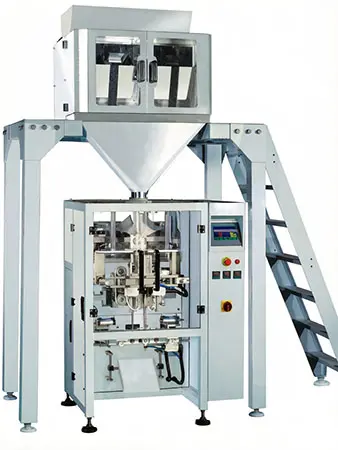
A continuous vacuum conveyor operates without interruption, using a rotary valve or twin-port vacuum technology to maintain a constant material flow. While vacuum suction is always on, the inlet and discharge are cleverly managed to allow simultaneous loading and unloading.
Features And Best For:
Uninterrupted, steady material transfer.
Short to medium distances.
Consistent, moderate to high throughput needs.
| Model | BEV-2 | BEV-3 | BEV-4 | BEV-5 | BEV-6 | BEV-7 | BEV-10-6 | BEV-20-5 |
| Capacity(KG) | 50-300 | 300-600 | 600-1000 | 1000-1500 | 1500-2500 | 2500-3500 | 5000-8000 | 7000-10000 |
| Vacuum pump power | 2.2kw | 3kw | 4.0kw | 5.5kw | 5.5kw | 7.5kw | 7.5kw | 11kw |
| Air flow (L/min) | 8L/min | 10L/min | 12L/min | 12L/min | 12L/min | 17L/min | 34L/min | 68L/min |
| Air supply pressure(Mpa) | 0.5-0.6mpa | 0.5-0.6mpa | 0.5-0.6mpa | 0.5-0.6mpa | 0.5-0.6mpa | 0.5-0.6mpa | 0.5-0.6mpa | 0.5-0.6mpa |
| Dimensions(mm) | ø290×996 | ø290×996 | ø420×1328 | ø420×1328 | ø420*1328 | ø420*1420 | ø600×1420 | ø800×1420 |
Configuration and application of the vacuum conveyor
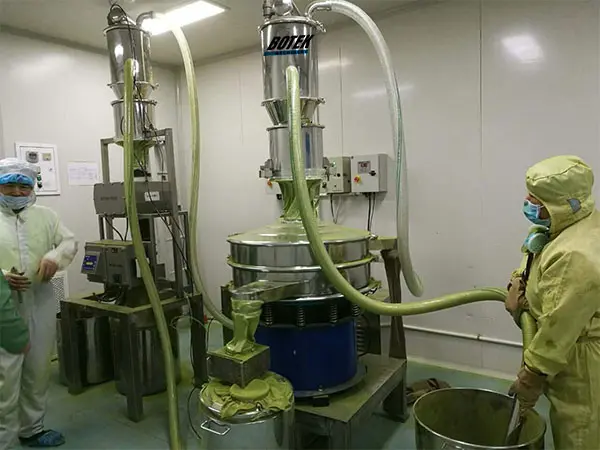
The vacuum conveyor feeds material into a vibrating screen
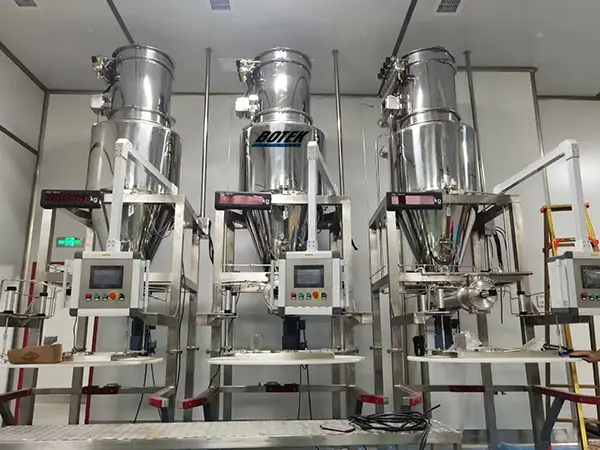
The vacuum conveyor is integrated with a weighing and batching system
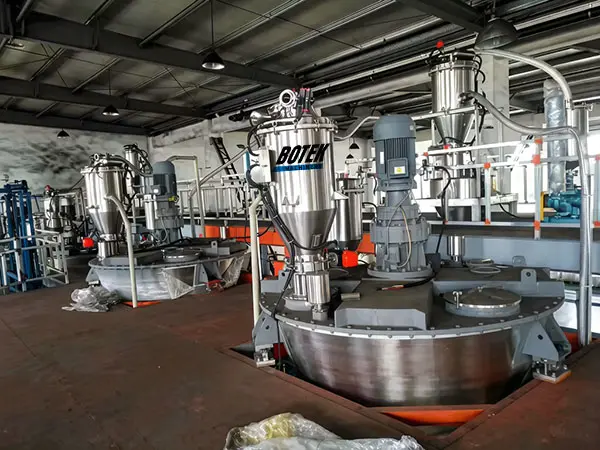
The vacuum conveyor transfers material into a Conical screw mixer
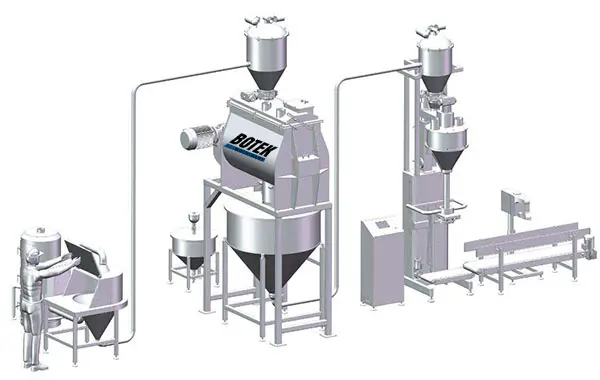
Beyond the conveyor, do you need other equipment?
FAQ
key difference is cleanliness, flexibility, and containment.
ناقل فراغ: Completely enclosed, preventing dust and contamination. Ideal for food, pharma, and toxic materials. Layout is flexible as lines can bend around obstacles. Easy to clean and suitable for multiple source/destination points.
الناقل اللولبي / Bucket Elevator: Mechanical systems. Risk of dust emission at transfer points. More difficult to clean. Layout is fixed and linear. Often used for longer-distance, high-volume transport of less sensitive materials.
Our systems can handle a vast range of dry solids, including:
Fine Powders: Flour, silica, titanium dioxide, API (< 50 microns)
Granules & Pellets: Plastic resins, grains, coffee beans
Flakes & Fibers: Flaked materials, short fibers
Blends: Pre-mixed materials
Crucially, the system must be tailored to the material. Factors like bulk density, particle size, flowability, and abrasiveness determine the optimal pump, filter, and line size. We offer free material testing to guarantee performance.
The choice depends on duty cycle, distance, and material.
Electric Vacuum Pump (or Blower) System: Best for continuous or high-duty cycle operation. It’s more energy-efficient for frequent conveying, can handle longer distances (>20m) and higher capacities. It requires an electrical connection.
Venturi (Compressed Air-Driven) System: Simpler, with no moving parts. Powered by plant compressed air. Ideal for intermittent duty, shorter distances, and lower capacities. It can be cheaper upfront but has higher operating (air consumption) costs for frequent use. Often used for portable applications or in explosive atmospheres (ATEX) as it’s intrinsically safe.
Our standard systems are engineered for robust industrial performance:
Conveying Distance: Typically up to 30-50 meters horizontally and 15-25 meters vertically in a single stage. For longer distances, we design multi-stage or booster systems.
Conveying Rate: From a few kg/hr for laboratory use to over 10 tons/hour for production lines. The rate depends on material density, distance, and pipe diameter.
We make integration straightforward. Our systems are pre-assembled and tested before shipment. Installation typically involves:
Positioning the unit.
Connecting the vacuum source (power or air).
Installing the suction lance into the source container.
Connecting the discharge outlet to your process machine (mixer, hopper).
Connecting the control signal (often a simple 24VDC start/stop).
We provide detailed manuals, 3D layouts, and on-site or remote commissioning support.
Maintenance is minimal but crucial:
Daily/Weekly: Check filter condition visually. Empty source and destination filters if present.
Monthly: Inspect filter elements for damage or blinding. Check seals and gaskets.
As Needed: Replace filter elements (typically every 6-12 months depending on material). Lubricate discharge valves as per manual.
The HMI can be programmed to alert operators for scheduled filter cleaning or maintenance.